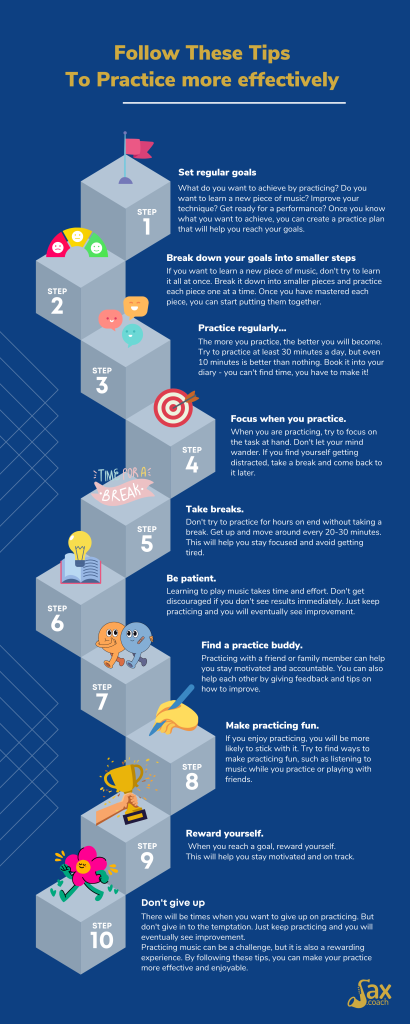
Music practice is not only a fulfilling and rewarding experience but has also been found to have numerous benefits for cognitive, emotional, and social development. Studies have shown that regular music practice can improve memory, language, and mathematical skills, as well as reduce stress and anxiety levels. At Sax.Coach I’m working hard to make it easier for you to practice and I’m constantly thinking of new ways to help you.
Did you know that one study published in the Journal of Neuroscience found that musicians have enhanced neural processing and more efficient communication between different areas of the brain compared to non-musicians? This improved connectivity can lead to better memory, language processing, and cognitive flexibility, all of which are important skills in various aspects of life.
Practice has also been found to have a positive impact on emotional regulation and stress reduction. A study published in Psychology of Music found that playing music, especially in a group setting, can lead to a reduction in stress hormones like cortisol and an increase in feelings of well-being and social connectedness.
Furthermore, music practice has been shown to have social benefits, such as improved communication skills and a greater sense of empathy. A study published in the Journal of Research in Music Education found that participation in a school band or orchestra was associated with higher levels of empathy and social responsibility among adolescents.
In addition to these cognitive, emotional, and social benefits, music practice can also provide a sense of personal fulfillment and enjoyment. Playing music can be a form of self-expression, creativity, and relaxation, providing an outlet for emotions and a means of connecting with oneself and others.
While these benefits may be more pronounced for those who practice music regularly and for an extended period, even a brief music practice session can have positive effects. A study published in the International Journal of Music Education found that just 20 minutes of music practice per week can lead to improvements in memory and attention span among school-aged children.
Practice is not only a means of developing musical skills and creativity but also has numerous cognitive, emotional, and social benefits. The effects of music practice can be seen in various aspects of life, including memory, language, and mathematical skills, emotional regulation and stress reduction, social skills, and personal fulfillment. Whether practicing for personal enjoyment or pursuing a career in music, the benefits of music practice can be enjoyed by all.
Download my 10-step practice infographic for more.